When people talk about building with natural materials like straw, one question comes up almost immediately.
What about moisture?
It is a fair question. Moisture is one of the most common concerns around bio-based construction and also one of the most misunderstood.
At EcoCocon, we do not treat moisture protection as a secondary issue or a risk to be managed later. We treat it as a system-level design principle, embedded at every step of the process, from the field where the straw is harvested to the building that stands decades later.
In natural construction, moisture is not a material problem.
It is a design, process, and execution challenge.
Here is how we approach it and why this way of thinking matters far beyond EcoCocon panels alone.
Key takeaways (TL;DR)
- Straw performs exceptionally well when moisture is managed as a system.
- Keep the straw dry - the critical threshold is 20% moisture content.
- The highest moisture risk occurs during construction, not during use.
- Moisture visibility is a safety feature, not a weakness.
- System design matters more than the material itself.
Starting Right: Moisture Control Begins at the Source
Good moisture protection starts in the field, long before production.
EcoCocon works closely with farmers local to our production facilities to ensure straw is harvested under the right conditions. Straw is cut only when fully mature, on dry and sunny days, and never when morning dew could introduce additional moisture. Before baling, moisture levels are measured to confirm the straw is below 20%, a value that plays a central role throughout the entire manufacturing and building process.
After harvesting, straw bales are stored in well-ventilated warehouses and checked again before entering production.
Why this matters beyond EcoCocon?
Moisture management in bio-based buildings does not start on the construction site, it starts much earlier in the material supply chain. It’s too late to address moisture only at the installation phase.
.jpeg)
Controlled Production and Storage
During manufacturing, every EcoCocon panel undergoes multiple moisture checks. These ensure that the straw remains dry throughout production and complies with the quality assurance requirements.
Finished panels are stored in dry, ventilated warehouses. Just before shipping, moisture of each panel is again measured and a list of moisture values for all panels accompanies the shipment. By the time a panel leaves our facility, it has passed several layers of quality control, not as a formality, but as a prerequisite for long-term quality assurance.
The broader lesson.
Natural materials are no less reliable than conventional ones. They simply demand the same or higher level of process discipline with good quality control, documentation and repeatability.
What Happens When Panels Arrive on Site
Once panels arrive on site, careful handling and weather protection remains essential. Straw moisture content must stay below 20%. There are three basic scenarios:
1. When the panels are supplied naked (this is typical for smaller or medium sized projects), for short-term outdoor storage we recommend using heavy-duty tarpaulins to protect panels from rain while still allowing airflow. For longer storage periods, a dry warehouse is recommended, with panels spaced slightly apart and kept dry.
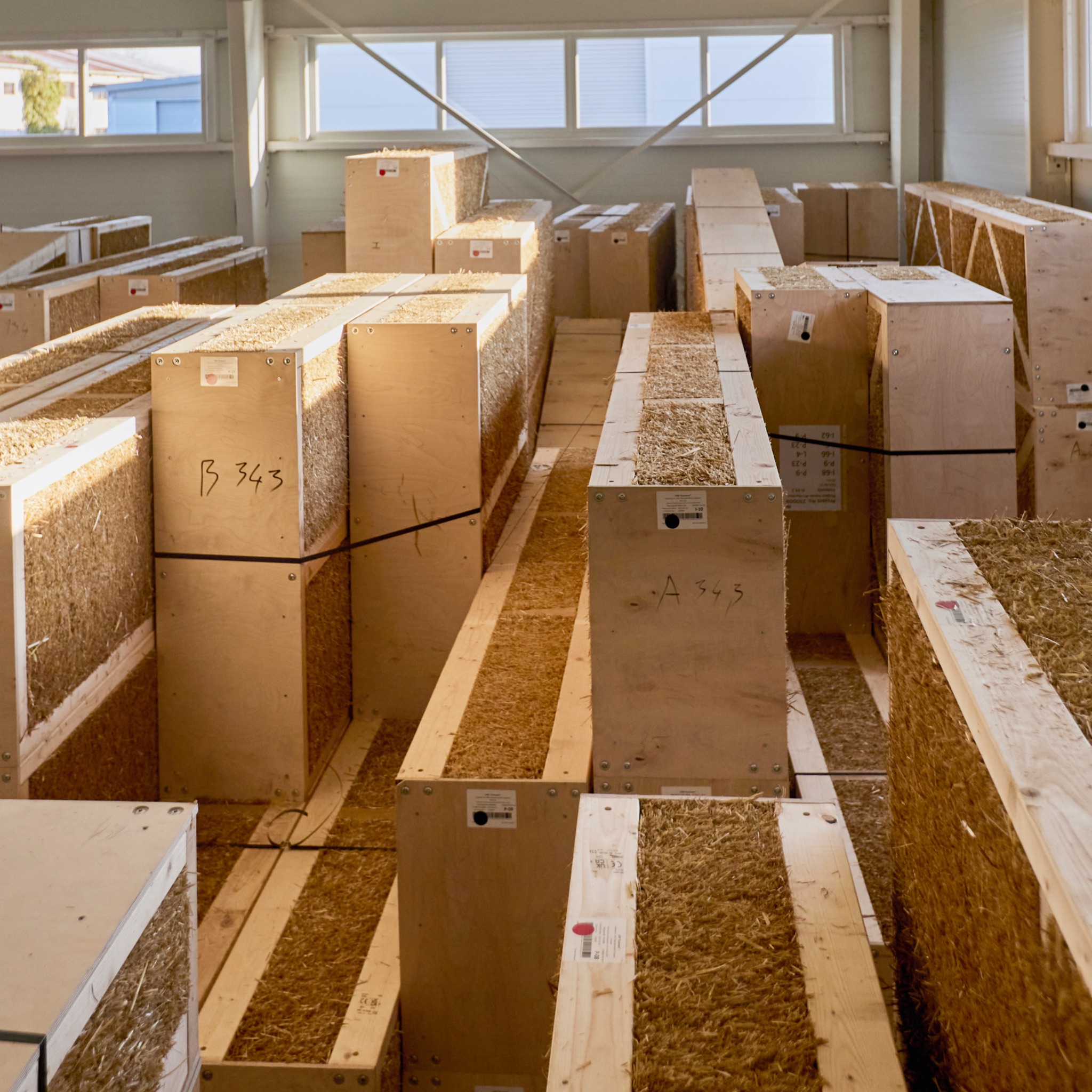
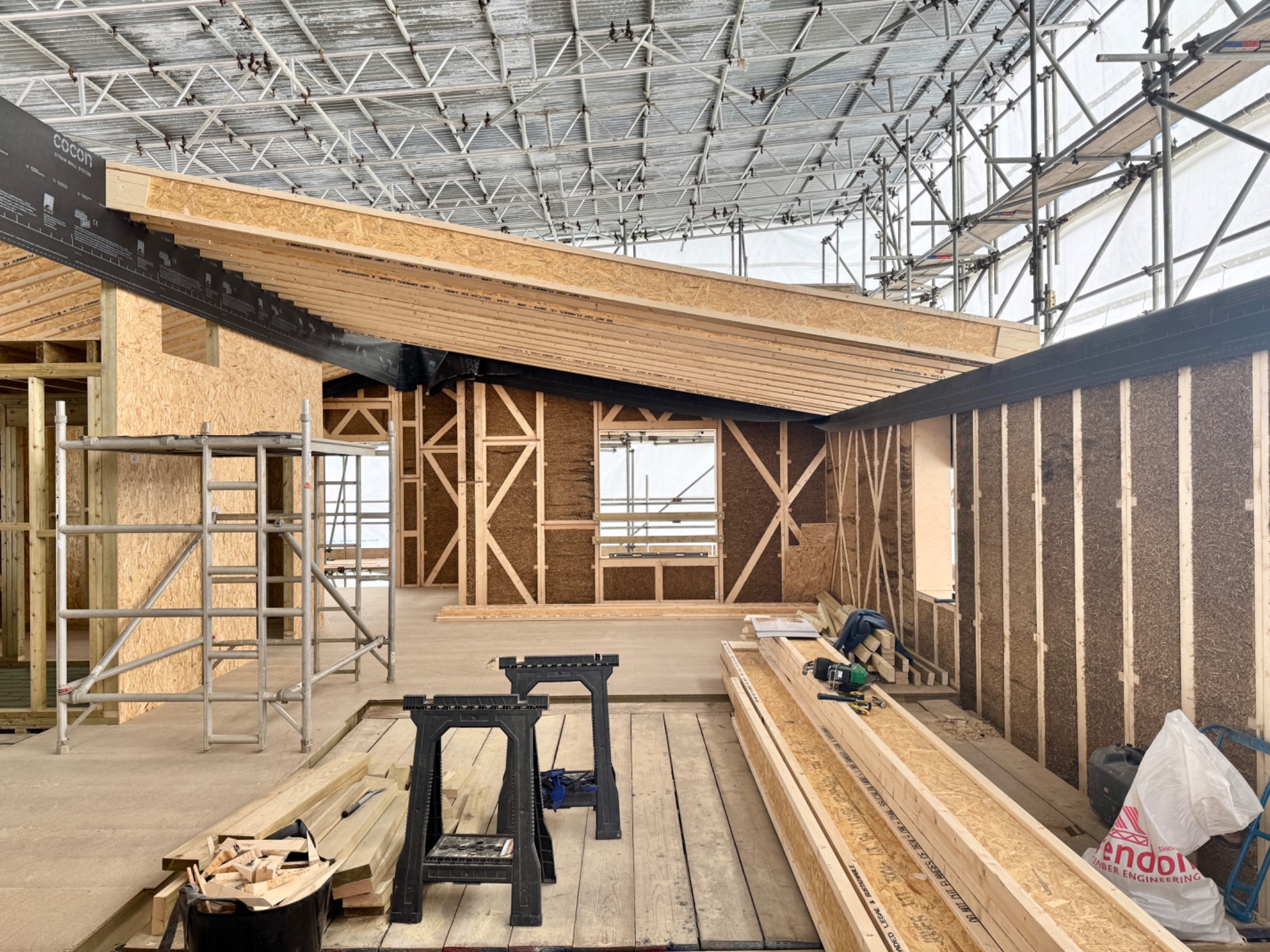
2. One of the most effective protection strategies is the use of a scaffold tent over the construction site. These tents protect the building and workers from rain, wind, and sun, and can be rented for the construction period. Panels can be moved by forklift through openings in the tarpaulin, and the roof structure can be assembled under cover, often without the need for a crane.
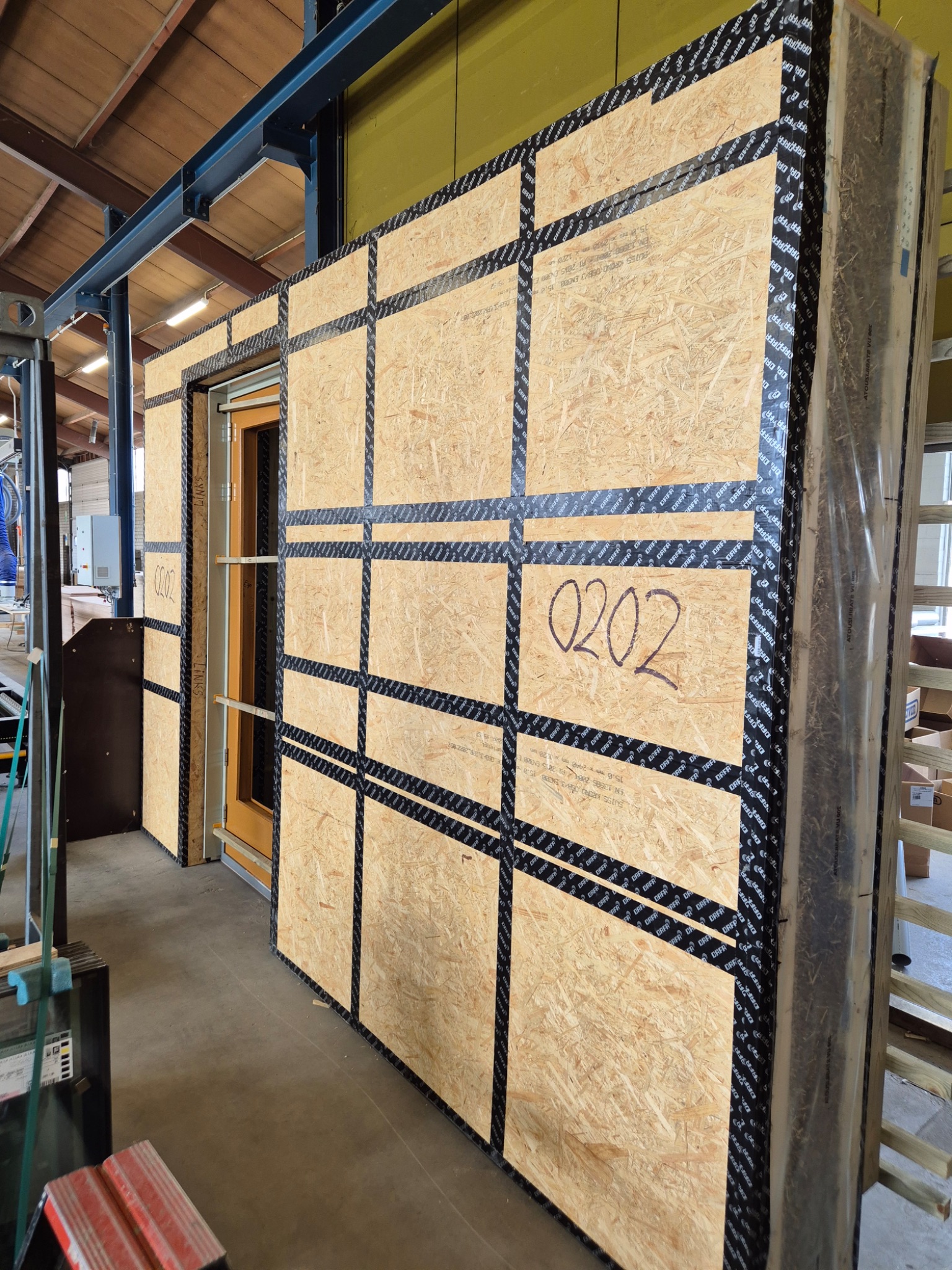
3. Panels can also be pre-assembled into larger wall elements in a local production hall, complete with airtight layers, temporary protection, and even pre-installed windows. These elements are then delivered to site and rapidly erected by a crane, reducing exposure time and minimising risk of moisture damage. This option is typical for larger projects, or for projects where shorter construction programmes are desired.
Important context
The construction phase is where moisture risk is highest. This applies not only to straw systems, but to most building methods. Managing this phase well is a question of planning, sequencing, and protection, more than material choice.
Moisture Protection During Construction
Construction is the most critical phase for moisture control. Straw must remain dry at all times.
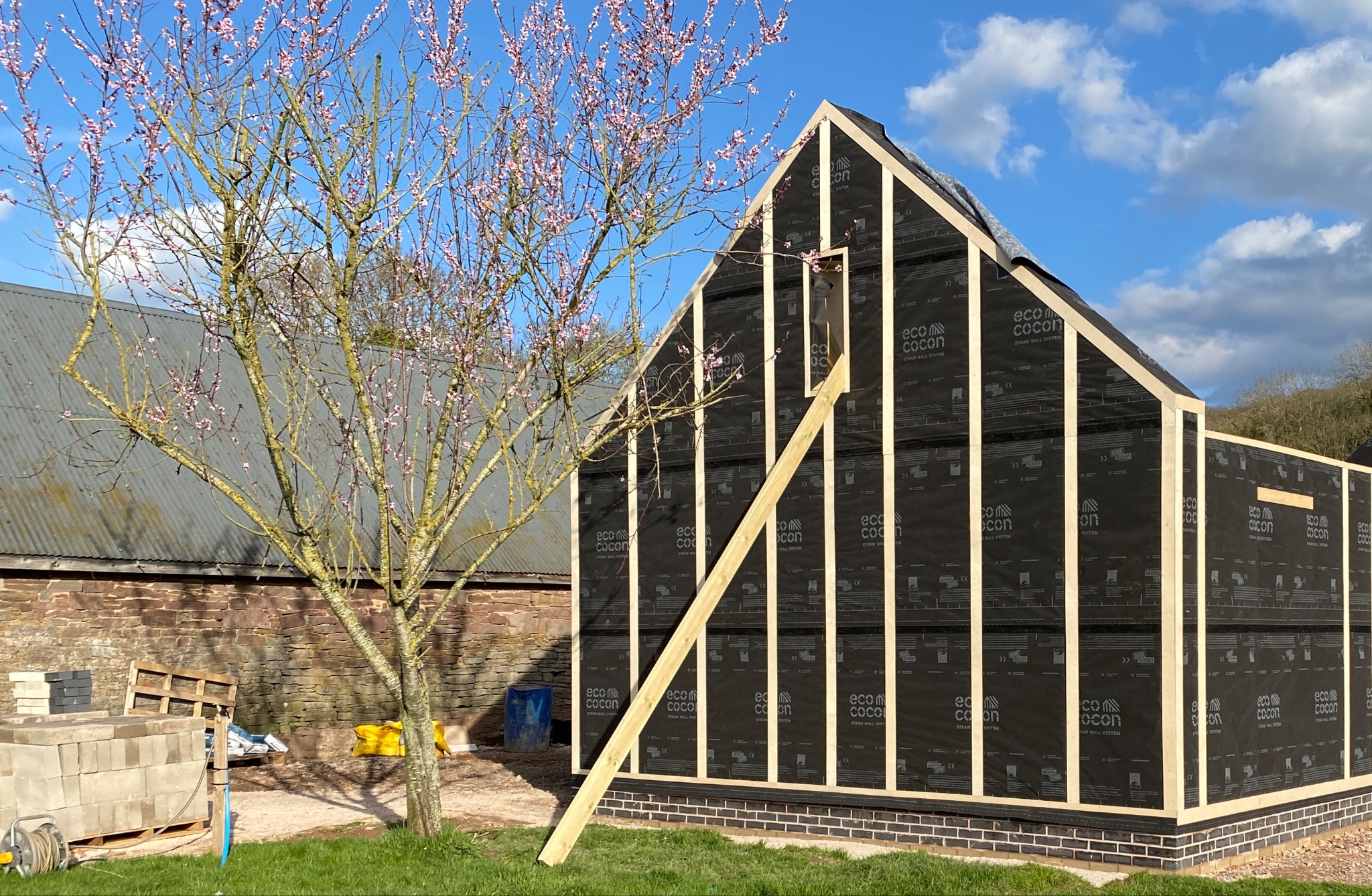
While light surface moisture can evaporate naturally, deeper moisture ingress must be actively prevented. EcoCocon panels are designed to work within airtight yet vapour-open assembly systems. This allows moisture to escape safely while preventing water from entering.
During construction, panels are protected by membranes, and all joints, openings, and connections are carefully sealed. Windows, doors, and roof details receive particular attention, not because straw is vulnerable, but because these are common weak points in any building system.
What If Straw Gets Wet?
With the best intentions on site things sometimes go wrong. Tarpaulins get torn in high winds, or membranes get damaged by accident. Straw with a moisture content exceeding 20% for prolonged periods, especially in warm conditions, can deteriorate. That is why fast detection and action are essential.
EcoCocon systems are designed to make moisture visible early, particularly when the panels are still naked, or when the surfaces are plastered. Natural plasters applied directly to the panels show signs of dampness quickly, allowing issues to be addressed before serious damage occurs.
Unlike hidden insulation systems, EcoCocon panels can be inspected and, if necessary, dried using controlled airflow.
Surface moisture or moisture up to approximately 50 mm depth can usually dry naturally or with assisted ventilation. Deeper moisture requires more targeted drying methods. In such cases, consultation with a local Technical Sales Consultant is recommended.
A key principle
In building physics, systems that reveal problems early are often safer than those that hide them until it is too late.
Why EcoCocon Panels Perform Differently
Many conventional timber-based systems are also vulnerable to moisture, but often address the risks too late or too locally. EcoCocon takes a system-first approach.
- Airtight by design – not as an afterthought. Vapour open airtightness membrane is an inherent part of our wall assembly. Applied to the outside of the panels, it provides a simple airtightness layer, not compromised by any internal junctions.
- High-density straw insulation that doesn’t settle over time, avoiding gaps and cold spots. Highly compressed straw with density of 115kg/m3 is factory installed into the panels, maintaining its thermal properties over the whole life of the building.
- Thermal-bridge-free design that reduces condensation risk. Our panels are twin stud timber frame; outer and inner studs are typically only joined by two thin plywood boards at top and bottom of each panel. This significantly reduces thermal bridging across the panels. A rigid woodfibre insulation board is typically installed to the outside of the panels, providing additional layer of continuous insulation and reducing any residual thermal bridges further.
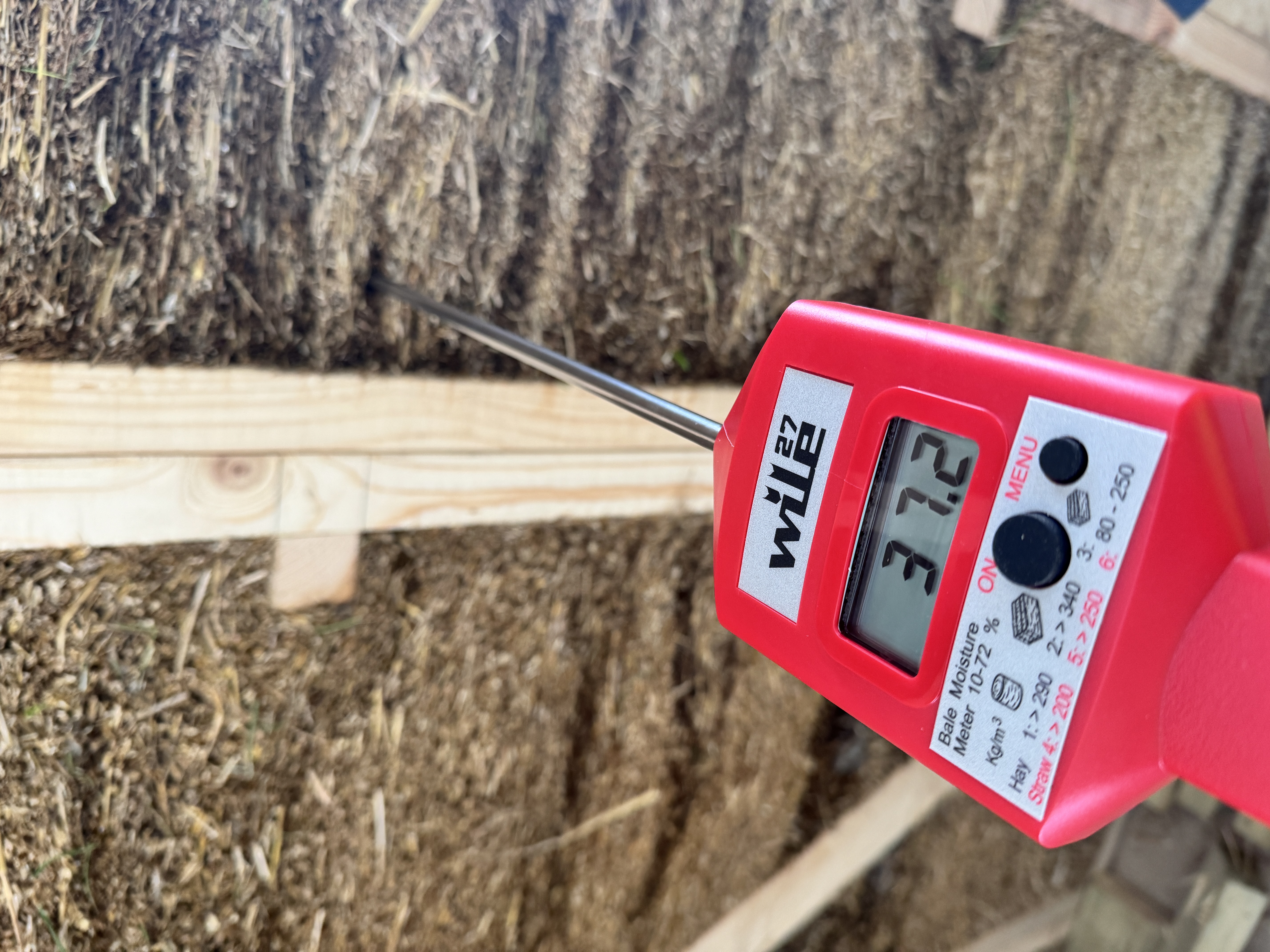
- Visible moisture detection, so problems can’t hide inside walls. Any moisture that gets into the panels during construction is visible in the straw, or in the clay plaster applied internally. Regular checks of moisture levels with moisture meter during the assembly are essential part of the construction process.
- Proven performance using WUFI moisture risk simulations to verify long-term durability. WUFI is a simulation software that enables realistic calculation of heat and moisture transport in building components. We have several WUFI models available for various climates that predict and verify moisture-related risks such as mould growth, rot, and structural damage. Custom calculations for your specific project are available.
The takeaway
Performance in natural construction comes from system design, not from treating individual components in isolation.
Long-Term Peace of Mind
When installed correctly, EcoCocon panels and membranes require no maintenance themselves. Regular upkeep of roofs, facades, and window connections is sufficient to ensure water stays where it belongs, outside the building envelope.
By combining careful sourcing, controlled production, thoughtful design, and clear construction guidelines, EcoCocon offers a natural building system that is not only sustainable but also robust, predictable, and built to last.
Natural materials can perform exceptionally well when they are treated with respect, discipline, and system-level thinking.
That is not just how we build at EcoCocon. It is how bio-based construction scales responsibly.