
The construction sector is responsible for around 40% of global carbon emissions. A large share of that burden sits quietly underground — in the foundations. Reinforced concrete, the default material for the vast majority of building foundations built in the last century, is one of the most carbon-intensive materials in existence. Steel production alone accounts for roughly 8% of global CO₂ emissions. Yet foundations are rarely the first thing people ask about when discussing sustainable buildings.
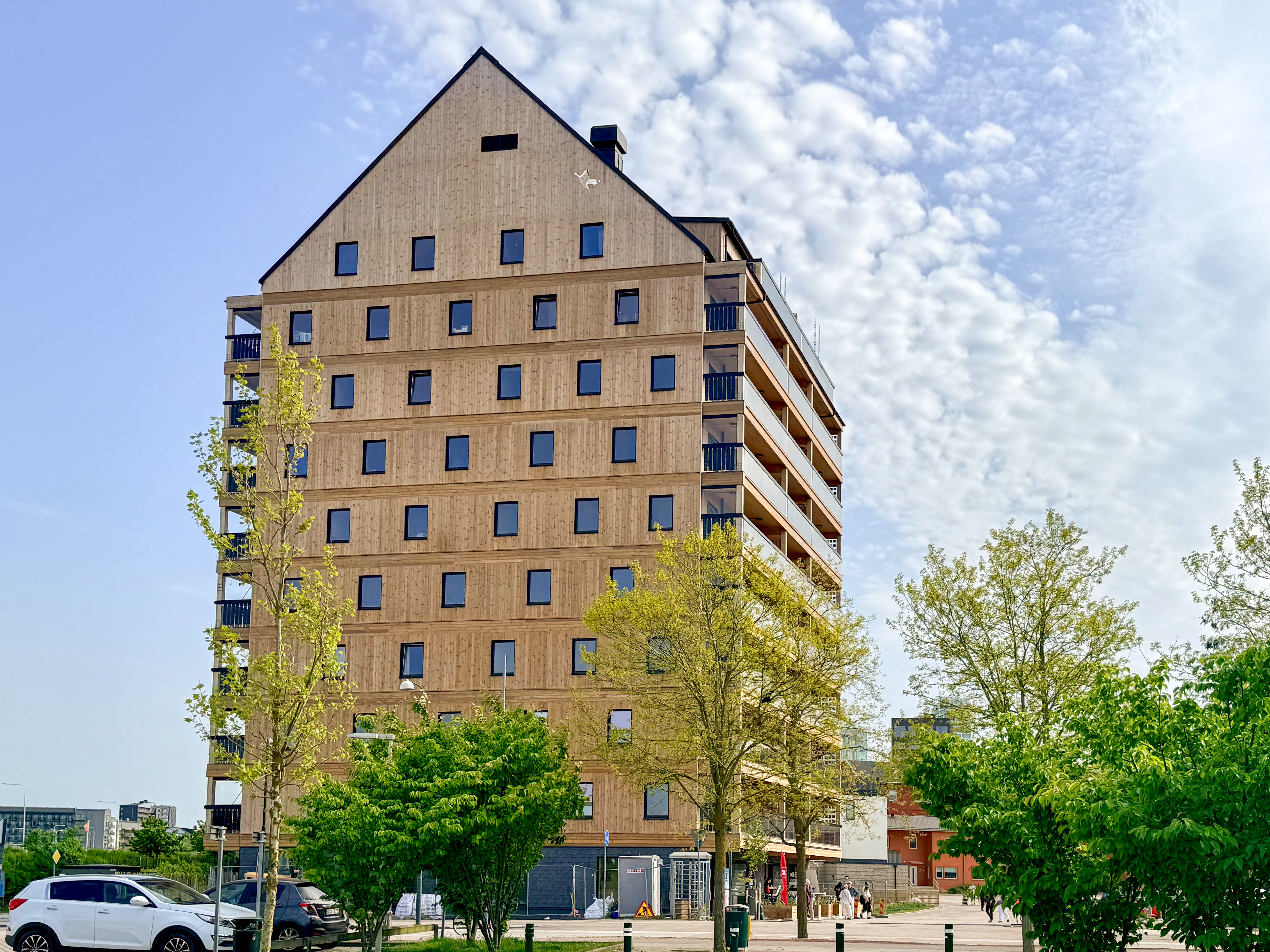
At ETC Hyllie, the world's tallest straw building, the project team decided early on that reducing the carbon footprint of the foundations was not optional — it was part of the brief.
Set in stone?
The ambitions for the Hyllie foundations started even more radically than what was eventually built. The design team developed a concept for a granite-block basement — a genuinely ancient material used without the carbon burden of Portland cement. It was a compelling idea. The economics, however, did not support it at this stage.
So the team moved to the next question: if the material has to be concrete, how do we make it as different from conventional concrete as possible?
Think lighter first
Before getting into the concrete mix itself, there is a more fundamental principle at work: the heavier the building, the larger and deeper its foundations need to be. This is where the choice of superstructure directly determines the carbon footprint of everything below ground.
Hyllie's 12-storey structure is built from a CLT and glulam frame, with EcoCocon straw panels as the external wall system. The central stair and lift core — an element typically built in concrete — is also entirely built from mass-timber CLT. The result is a building that weighs dramatically less than an equivalent concrete-framed structure.
Less weight means less foundation. That single decision — to commit to a bio-based hybrid superstructure — significantly reduced the volume of concrete required for the foundations, removing a large share of embodied carbon from the project before the mix design was even discussed.
The problem nobody expects: a building that could float
Lightness, though, creates an engineering problem that conventional construction rarely has to think about.
During construction at Hyllie — before the upper floors and roof were in place — the accumulated mass of the building was low enough that a significant rain event could have raised groundwater levels around the partly built basement to a point where the structure would literally float. What engineers call a 50-year rain event: a flood of the magnitude that statistically occurs roughly once every half-century.
Fredrik Fagerberg, CEO of ETC Byggentreprenad, describes it plainly: "We need to pump out the water around the building during erection to monitor the actual floating capacity. It's not until we have the last layer of the roof structure that we have enough mass to stop water from seeping in around the building. So that is a little bit special."
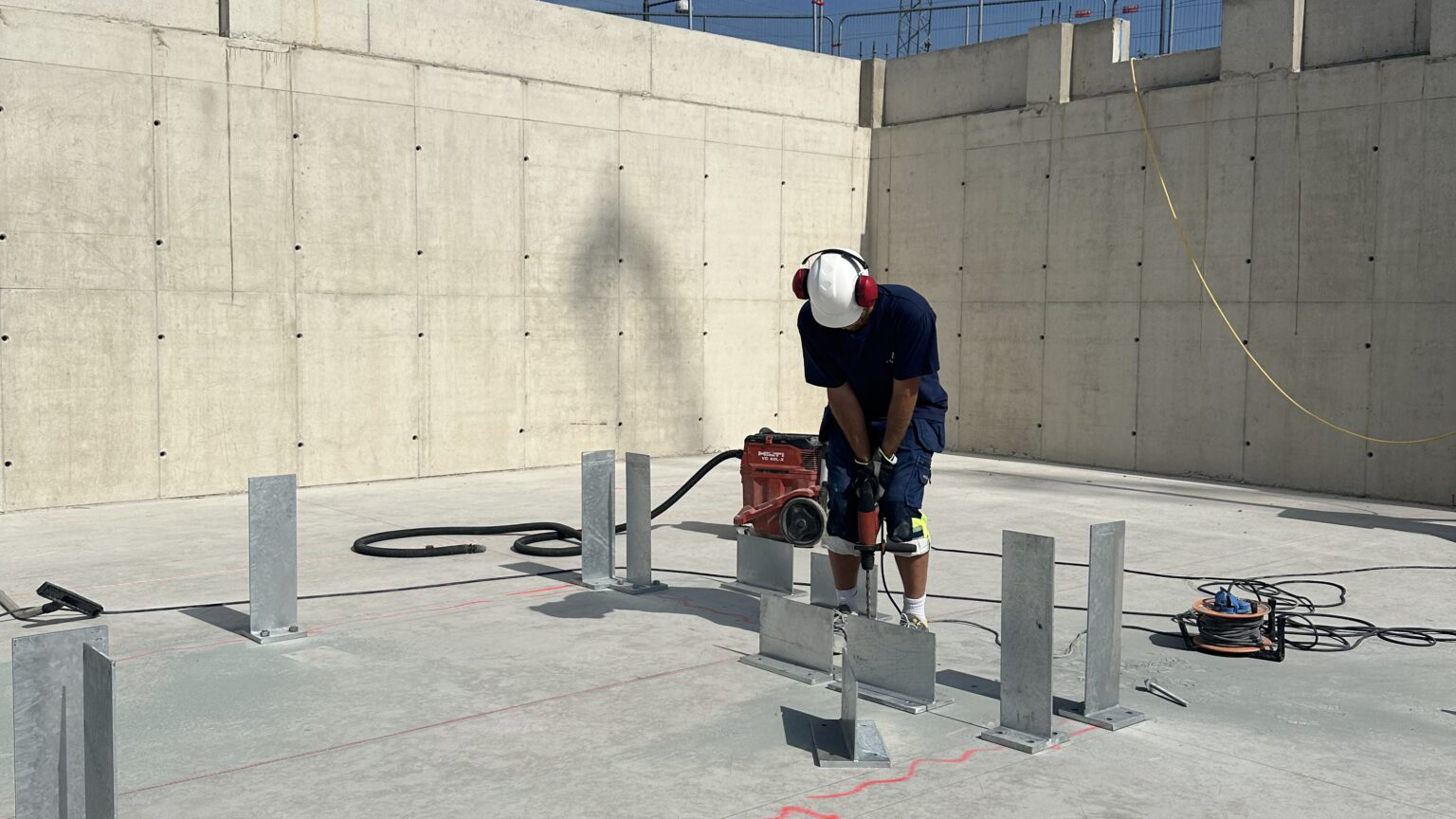
Once complete, the challenge shifts to wind. A 12-storey building in exposed Malmö carries substantial lateral loads. The entire structural logic routes those forces through the CLT core walls and down into the foundation connection — a detail that required a purpose-built engineering solution ETC had not used before at this height. The building stands.
Built to last: lessons from ancient Rome
The Pantheon in Rome has stood for nearly 2,000 years. Roman concrete achieved this through a self-healing mechanism and a mix of volcanic ash and quicklime that modern materials scientists are still studying. Modern Portland cement-based concrete, by contrast, is typically designed for a 60–100 year lifespan. It develops cracks, and those cracks allow moisture in, which corrodes the steel reinforcement, which expands as it rusts, causing the concrete to spall. The failure mechanism is built into the specification.
At Hyllie, the team addressed this fundamental vulnerability by removing steel entirely from the equation.
Basalt rebar: the volcanic alternative to steel
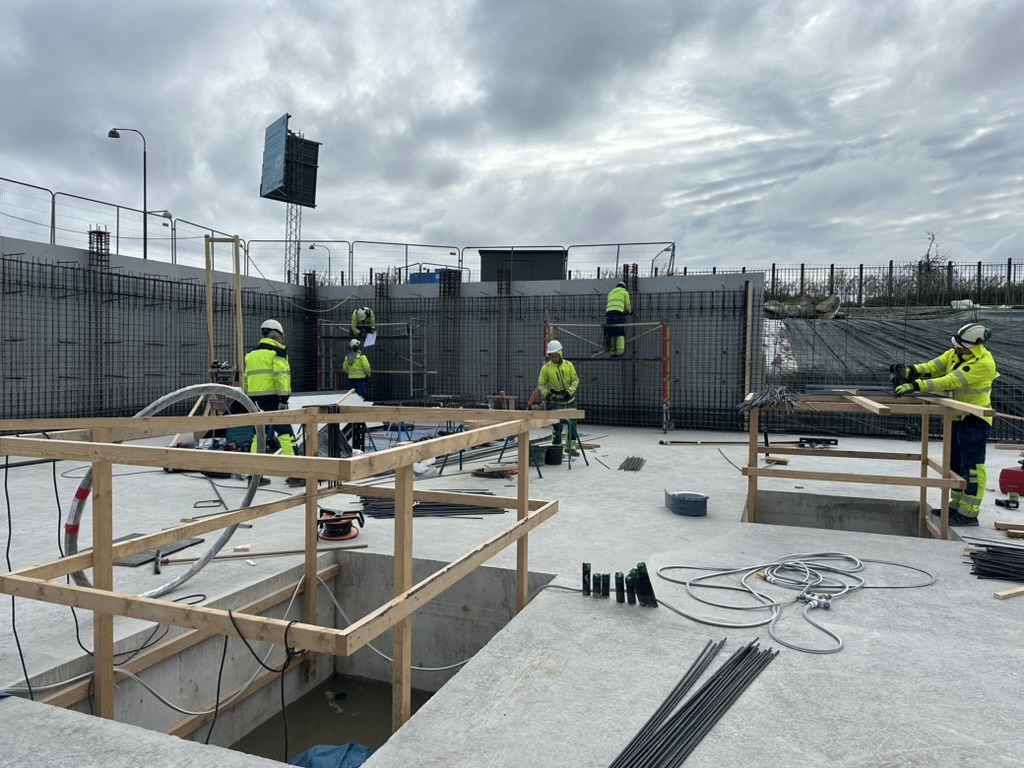
Traditional steel rebar throughout the Hyllie foundations has been replaced with basalt fibre reinforced polymer (BFRP) rebar. The material is made by crushing basalt rock — one of the most abundant minerals on earth — melting it, drawing it into continuous fibres, and binding those fibres into rods with epoxy resin. The result is a reinforcement bar that serves the same structural purpose as steel but with fundamentally different material properties.
The key advantages are:
No corrosion. Basalt does not rust. In a basement environment where moisture is a permanent consideration, this matters not just for the initial carbon calculation but also for the structure's longevity over its full lifetime.
Higher tensile strength. Basalt rebar has approximately twice the tensile strength of conventional steel rebar. This means less reinforcement is needed overall to achieve the same structural performance — and because it does not corrode, the required concrete cover over the bars can be reduced. Both factors reduce the volume of material used.
Cost-neutral. The unit cost of basalt rebar is higher than that of steel, but because only approximately half the quantity is required, the overall cost difference between the two options is broadly neutral.
Easy to work with on-site. Basalt rebar weighs roughly a quarter of equivalent steel. It does not require heavy lifting and does not cause the strain injuries associated with large steel mesh installations. The one adaptation at Hyllie was that pre-manufactured basalt mesh was not yet widely available, so the rebar mesh was assembled on-site from individual rods. Given the material's weight, this presented no real obstacle. As Fagerberg notes: "It's quite easy to work with, actually."
The concrete itself: a 68% carbon reduction
Alongside the basalt rebar, the team developed a proprietary low-carbon concrete mix. The primary lever is reducing the Portland cement content—the main source of carbon emissions in conventional concrete—and replacing it largely with fly ash—a by-product of coal combustion that acts as a supplementary cementitious material. The result is a concrete mix with 68% lower carbon emissions compared to a standard specification.
One note worth making for anyone following this approach: when evaluating proposals from concrete suppliers, it's essential to compare like-for-like. Carbon reduction claims in this sector can be significantly overstated if the baseline is not clearly defined. The 68% figure at Hyllie is measured against a standard Portland cement mix, on a consistent methodology.
Combined, the low-cement concrete mix and basalt reinforcement deliver a foundation with approximately 70% less embodied carbon than a conventional equivalent — Fagerberg's own estimate, with full lifecycle calculations now being finalised, with the building now complete.
What this means for bio-based construction
The decisions made in the Hyllie foundations demonstrate something important: reducing a building's carbon footprint is not a single decision made at the superstructure level. It is a sequence of choices that runs through every element, including the parts that will never be seen once the building is occupied.
The lightweight bio-based superstructure reduced the required volume of concrete. The low-cement mix reduced the carbon intensity of that concrete. The basalt rebar eliminated the corrosion failure mechanism that limits the lifespan of conventional reinforced concrete, while also reducing the amount of reinforcement required. Each decision compounded the last.
Building with bio-based materials is not just a question of what goes in the walls. It is a question of what the entire building is built from, from the ground up.
Next: how Hyllie was engineered for fire safety — and why a bio-based 12-storey building can offer protection the concrete industry does not want you to know about.
